 GOLDSNIPER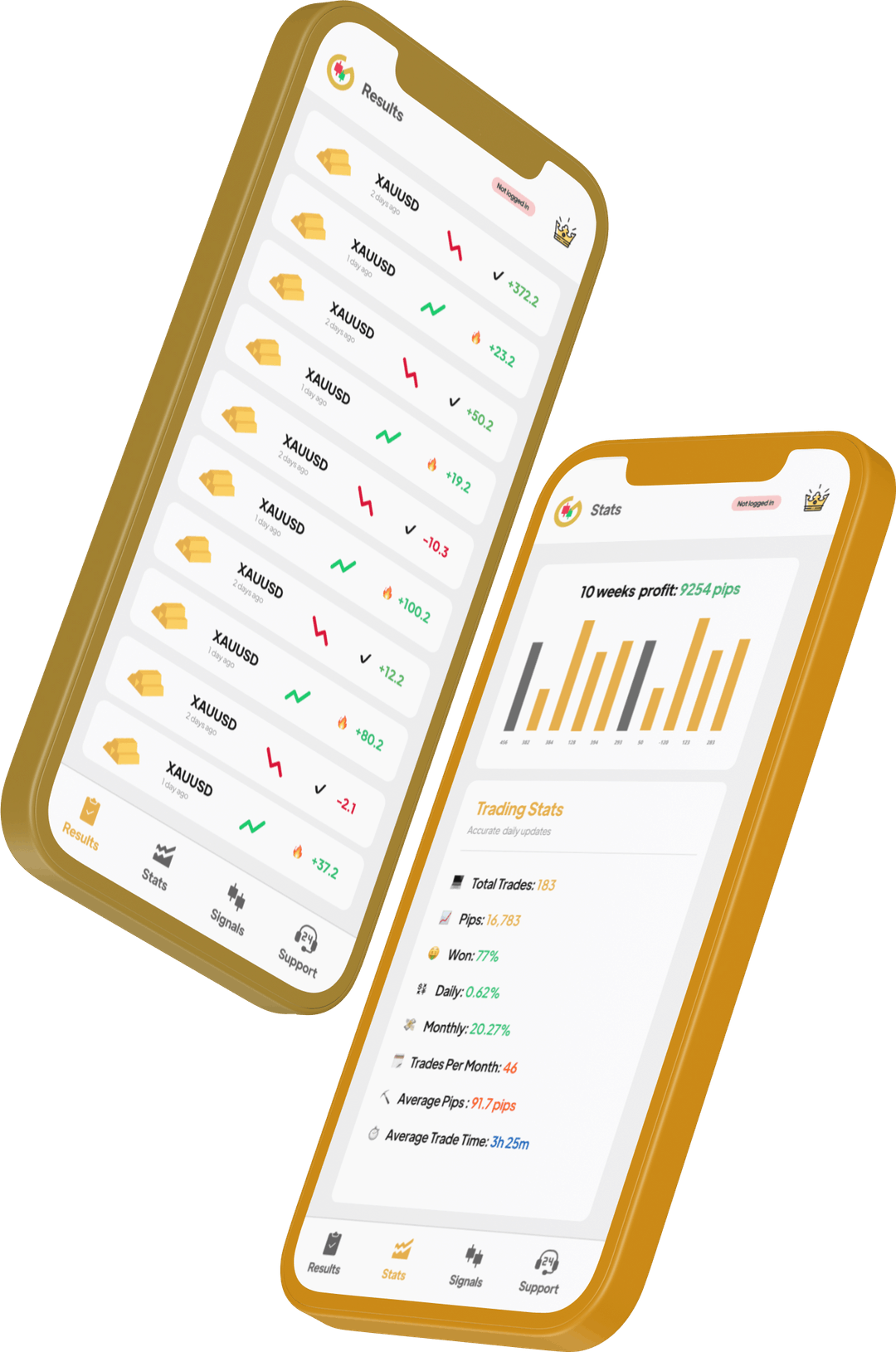
Why most gold traders lose money.
Broker disclosures consistently show that 70–80% of retail CFD traders lose money. In gold trading specifically, the loss rate may be even higher due to the instrument's volatility. Understanding why traders lose is the first step to making sure you don't become another statistic.
Overleveraging
The number-one account killer. A trader with a $1,000 account opens a 0.50 lot gold position — that's 50 oz, or $117,500 in notional value at $2,350/oz. Gold drops 200 pips (a perfectly normal intraday move), and the account is down $100 — 10% of the account — on a single trade. Two or three of these, and the account is in serious trouble. Most beginners don't realize how quickly gold can move against them because they're used to the gentler movements of EUR/USD.
No stop-loss
Some traders avoid stop-losses because they "don't want to get stopped out." This is catastrophic logic. Without a stop-loss, a single adverse move can wipe out weeks or months of profits. Gold regularly gaps and spikes during news events. On May 4, 2023, gold dropped $40 (400 pips) in under 90 minutes following the Fed decision. Traders without stop-losses who were long lost 400 pips × their lot size — and many hit margin calls.
Emotional decision-making
Revenge trading after a loss. Moving your stop-loss further away "to give it room." Doubling down on a losing position because "it has to come back." Taking profit too early because of fear. Holding a losing trade because of hope. These emotional responses are universal — every trader experiences them. The difference between winners and losers is whether they have a system to override these impulses.
No trading plan
Trading without defined rules is gambling. A trading plan specifies: what you trade, when you trade, how you enter, where you place your stop-loss, where you take profit, how much you risk per trade, and what you do after a win or loss. Without these rules written down and followed consistently, every trade is a random bet influenced by whatever emotion is dominant at the time.
The 1% rule explained.
The 1% rule is the foundation of professional risk management: never risk more than 1% of your account balance on any single trade. This simple rule provides a mathematical safety net that protects you from ruin even during the inevitable losing streaks.
Here's why the math matters:
With 1% risk per trade
With 5% risk per trade
The key insight: losses compound asymmetrically. A 10% drawdown requires an 11% gain to recover. A 50% drawdown requires a 100% gain. A 90% drawdown requires a 900% gain. The 1% rule keeps your drawdowns in the easily recoverable range.
Practical example
You have a $5,000 account. The 1% rule means your maximum risk per trade is $50.
Risk per trade: 1% = $50
Stop-loss distance: 100 pips
Pip value per lot: $10/pip (standard lot)
Lot size = $50 / (100 pips × $10) = 0.05 lots
If stopped out: you lose exactly $50 (1% of account).
If TP hit at 200 pips: you gain $100 (2% of account).
Notice how the lot size adjusts based on stop-loss distance. A wider stop means smaller lots. A tighter stop means you can use slightly larger lots. The dollar risk stays constant at $50 regardless.
Position sizing for gold.
Position sizing is the mechanical process of determining exactly how many lots to trade based on your account size, risk tolerance, and the specific trade's stop-loss distance. It's the most important calculation in trading — more important than your entry, your analysis, or your indicators.
Example 1: Day trade with tight stop
Account: $2,000 | Risk: 1% = $20 | Stop-loss: 50 pips | Pip value: $10/lot
Lot size = $20 / (50 × $10) = 0.04 lots
Maximum loss if stopped: $20. Position value: $9,400. Effective leverage: 4.7:1.
Example 2: Swing trade with wide stop
Account: $10,000 | Risk: 1% = $100 | Stop-loss: 300 pips | Pip value: $10/lot
Lot size = $100 / (300 × $10) = 0.03 lots (rounded down)
Maximum loss if stopped: $90 (slightly under 1% due to rounding). Effective leverage: 0.7:1.
Example 3: Small account, micro lots
Account: $500 | Risk: 1% = $5 | Stop-loss: 100 pips | Pip value: $10/lot
Lot size = $5 / (100 × $10) = 0.005 lots
Most brokers allow minimum 0.01 lots, so you'd either widen your risk to 2% (0.01 lots = $10 risk) or use a tighter stop. This illustrates why very small accounts face constraints.
Critical rule: always round down. If the formula gives 0.037 lots, trade 0.03 — not 0.04. Rounding up increases your risk beyond the planned percentage. Precision matters; a few hundredths of a lot add up over hundreds of trades.
Four rules that protect your capital.
Six mistakes that destroy accounts.
Trading without a stop-loss
"I'll close it manually if it goes against me." You won't. You'll hope, wait, and watch your account bleed. A stop-loss removes the decision from your emotional brain and hands it to the platform. Every trade needs one — no exceptions.
Averaging down on losers
Adding to a losing position ("doubling down") is how small losses become account-ending losses. If gold is moving against you, adding more exposure increases your loss rate. Professional traders add to winners, not losers.
Revenge trading after losses
You lose a trade, feel angry, and immediately enter another trade to "make it back." This second trade is almost always larger, poorly planned, and emotionally driven. It usually loses too. Set a rule: after two consecutive losses, take a 1-hour break minimum.
Overtrading
Taking 15+ trades per day in search of action. Each trade has a cost (spread + commission) that compounds. More importantly, trade quality drops with quantity. The best gold traders take 2–5 high-quality setups per day, not 20 mediocre ones.
Moving stop-losses further away
Price approaches your stop-loss, so you move it 50 pips further to "give it room." This instantly increases your risk beyond what you planned. It's the emotional equivalent of doubling your bet at a casino because you're sure the next hand will win.
Risking too much per trade
Trading 0.50 lots on a $1,000 account because "this setup is perfect." No setup is perfect. Even the best strategies have 30–40% losing trades. Risking 5–10% per trade means 3–4 losses in a row takes 15–40% of your capital — a hole that's extremely hard to climb out of.
Where to place your stop-loss.
A stop-loss should be placed at the price level where your trade thesis is invalidated — not at an arbitrary number of pips from your entry. Here's how to determine stop placement for different trade types:
Support/resistance-based stops
If you're buying at a support level (say, $2,340), your stop goes below that support — typically 5–15 pips below the swing low that defines the support zone. If support is at $2,338 with a swing low at $2,335, place your stop at $2,332. This gives the trade room to test support without getting stopped on the wick, while invalidating the thesis if support genuinely breaks.
ATR-based stops
The Average True Range (ATR) measures typical volatility over a period. A common method: set your stop at 1.5× the ATR(14) from your entry. If the 14-period ATR on the H1 chart is 80 pips, your stop would be 120 pips from entry. This adapts automatically to current market volatility — tighter stops when gold is calm, wider stops when it's volatile.
Structure-based stops
For trend-following trades, place your stop below the last higher low (for longs) or above the last lower high (for shorts). This keeps you in the trade as long as the trend structure remains intact. When the structure breaks — when the higher-low pattern fails — you're stopped out because the trend may have reversed.
Trailing stops
Once a trade moves into profit, you can trail your stop-loss to protect gains. Common approaches:
- Breakeven trail: Move stop to entry once trade reaches 1:1 R:R.
- Partial close + trail: Close 50% at 1:1, trail the stop on remaining 50%.
- Structure trail: Move stop below each new higher low as price advances.
- ATR trail: Keep stop at 1.5× ATR behind the current price.
How GoldSniper handles risk.
Every GoldSniper signal comes with a pre-defined stop-loss and take-profit level. This isn't optional — it's built into every signal because we believe no trade should exist without a defined exit plan for both winning and losing scenarios.
Our signal structure ensures risk management by default:
You still need to calculate your own lot size based on your account balance and the signal's stop-loss distance. Use the position sizing formula above with our provided stop-loss distance, and you'll have the exact lot size that risks 1% of your specific account.
This approach means that even if a signal loses, the damage is contained to a small, pre-planned percentage of your capital. Our 93% accuracy rate means losing signals are rare — but when they do occur, they don't damage your account because the risk was defined from the start.
Why preventing drawdowns matters most.
The mathematics of recovery are brutally asymmetric. The deeper you draw down, the exponentially harder it is to recover. This table illustrates why capital preservation is the first job of every trader:
| Account Drawdown | Gain Needed to Recover | Difficulty |
|---|---|---|
| 5% | 5.3% | Easy |
| 10% | 11.1% | Manageable |
| 20% | 25.0% | Challenging |
| 30% | 42.9% | Difficult |
| 50% | 100.0% | Very difficult |
| 75% | 300.0% | Near impossible |
| 90% | 900.0% | Account is effectively dead |
This is why the 1% rule exists. With 1% risk per trade, even 20 consecutive losses (statistically extremely unlikely with a sound strategy) only results in an 18% drawdown — firmly in "manageable" territory. At 5% risk per trade, just 6 consecutive losses crosses into "very difficult" recovery territory. For prop firm-specific risk rules, see our guide on passing FTMO challenges with gold signals.
Risk management in practice.
See how GoldSniper signals include pre-calculated stop-loss and position sizing.
Frequently asked questions.
What is the 1% rule in trading?
The 1% rule means never risking more than 1% of your total account balance on any single trade. If your account is $10,000, your maximum loss per trade should be $100. You achieve this by calculating your lot size using the position sizing formula: Lot Size = Risk ($) / (Stop Loss pips × Pip Value). This ensures that even a streak of losses doesn't cause catastrophic damage to your account.
How do I calculate lot size for gold?
Use the formula: Lot Size = (Account Balance × Risk %) / (Stop Loss in pips × $10). For a $5,000 account risking 1% with a 100-pip stop: Lot Size = ($5,000 × 0.01) / (100 × $10) = $50 / $1,000 = 0.05 lots. Always round down if you get a non-standard lot size. With a wider 200-pip stop, the same calculation gives 0.025 lots — round down to 0.02.
How wide should my gold stop-loss be?
Stop-loss width should be determined by the trade setup, not by a fixed number. Place your stop at the price where your trade thesis is invalidated — below support for longs, above resistance for shorts. Typical ranges: scalping (30–80 pips), day trading (80–200 pips), swing trading (200–500 pips). Then calculate your lot size based on the stop distance to maintain 1% risk.
What's a good risk-to-reward ratio for gold?
Minimum 1:2 for most strategies, meaning your take-profit target should be at least twice your stop-loss distance. Gold's high volatility makes 1:2 and 1:3 ratios consistently achievable. With 1:2 R:R, you only need a 34% win rate to break even. With a 50% win rate, you net 1× risk per trade on average. Never take trades with less than 1:1.5 R:R — the math doesn't support long-term profitability below that threshold.
Explore more resources.
What is XAU/USD?
Complete beginner's guide to gold trading fundamentals.
Read more →Best Brokers for Gold
Compare top brokers — spreads, leverage, and regulation.
Read more →Trading Strategies
Proven gold strategies from scalping to swing trading.
Read more →Gold Trading Glossary
A–Z dictionary of every term you need to know.
Read more →Trading Tools
Position size calculator, pip calculator, and more.
Read more →Gold Signals
Professional signals with pre-built risk management.
Read more →Trade gold with defined risk.
Every GoldSniper signal includes pre-set stop-loss and take-profit levels. Free to download.